2026 Cybersecurity Training Guide for Alaska Businesses
Imagine your office manager receives a voicemail from you requesting an urgent wire transfer to a vendor. The voice sounds exactly like yours, right down to the unique inflection, but you never made that call. In 2026, AI-driven deepfakes have turned traditional defense on its head, making robust cybersecurity awareness training for employees the most critical investment in your company’s survival. Your team is no longer just a group of users; they are the primary targets of highly sophisticated, personalized deception.
It’s natural to feel concerned about the rising complexity of threats like business email compromise and the looming pressure of HIPAA violations. You want to protect your business without getting bogged down in technical jargon or fear-based tactics. This guide shows you how to build a proactive human firewall that guards your data and your reputation. We will walk through modern training strategies that address AI risks, explain how to navigate the 2026 Alaska Insurance Data Security Law, and provide a roadmap for maintaining full regulatory compliance. By the end, you will have a clear plan to foster a security-conscious culture that keeps your operations predictable and safe.
Key Takeaways
Understand why your staff is the most critical layer of defense and how to build a “human firewall” that stops threats technical filters miss.
Learn to identify sophisticated AI-driven deceptions, including voice cloning and deepfake videos designed to bypass traditional security checks.
Navigate the complexities of HIPAA and the 2026 Alaska Insurance Data Security Law with specific strategies for medical and financial practices.
Discover a five-step framework for implementing cybersecurity awareness training for employees that uses baseline phishing simulations to measure real-world readiness.
See how a managed partnership with a local Anchorage expert provides more protection and peace of mind than a standard software subscription.
Table of Contents
Why Employee Training is Your Strongest Defense in 2026
In the current digital climate, technical defenses have reached incredible heights. However, even the most advanced AI filters cannot stop every threat. This makes Security awareness training more than just a recommendation; it’s a fundamental pillar of your business continuity. Effective cybersecurity awareness training for employees isn’t an annual seminar that staff forgets by lunch. It’s a continuous educational process designed to sharpen instincts and build what we call a “Human Firewall.” Your team acts as the final line of defense when technical barriers are bypassed.
To better understand this concept, watch this helpful video:
While software handles the bulk of automated attacks, 2026 has introduced AI-driven threats that mimic human behavior with terrifying precision. If a malicious actor uses voice cloning to impersonate a supervisor, your firewall won’t flag the call, but a trained employee will. For Alaska’s small businesses, the stakes are high. Research from ORDR (2026) indicates the average cost of a data breach has risen to $4.88 million globally. Investing in proactive training is a fraction of that cost. It provides a layer of defense that no software can replicate.
The Psychology of a Cyberattack
Hackers don’t always “break in” through code; they often “talk” their way in. Social engineering is the psychological manipulation of people into performing actions or divulging confidential information. By exploiting trust, urgency, or fear, attackers convince employees to bypass security protocols. Even tech-savvy teams fall for these sophisticated 2026-era scams because they are designed to bypass our logical thinking and trigger an emotional response. We help your team recognize these triggers before they click.
Beyond the Completion Certificate
A “check-the-box” approach to security often leads to a false sense of safety. Real protection comes from a shift in behavior where security becomes a core business value. This is known as a security culture. Instead of long, exhausting annual seminars, we find that consistent, bite-sized learning improves retention. If your team encounters security concepts in small, manageable doses, they are far more likely to recognize a threat when it actually appears. Implementing cybersecurity awareness training for employees as a regular habit ensures your defense is always active.
Modern Threats: Beyond Basic Phishing to AI and Deepfakes
The days of spotting a scam by its poor grammar and generic greetings are gone. In 2026, Business Email Compromise (BEC) has evolved into a highly sophisticated operation powered by generative AI. These tools allow attackers to draft perfect emails that mirror the tone and style of your colleagues. This evolution is exactly why cybersecurity awareness training for employees must pivot toward identifying the subtle psychological cues of a modern attack rather than just looking for technical red flags.
Beyond email, we’re seeing a sharp rise in “Smishing” (SMS phishing) and “Vishing” (voice phishing). Attackers often use these mobile vectors to catch employees while they’re distracted or on the move. To stay ahead of these trends, many organizations look to resources like CISA cybersecurity training for additional frameworks. However, the most effective defense remains a team that knows what to look for during a high-pressure moment. If a digital communication feels slightly off, your employees need the confidence to pause and verify.
When reviewing suspicious messages, look for these AI-specific tells:
Overly formal or perfectly neutral language that lacks the sender’s usual “human” quirks.
Requests for urgent financial actions that bypass your standard internal protocols.
Links that lead to login pages requesting multi-factor authentication (MFA) codes.
Unusual sender addresses that mimic internal domains with one or two character changes.
Spotting AI-Generated Deception
Deepfake technology has made voice cloning a reality for small businesses. Attackers can now mimic an executive’s voice with just a few seconds of audio from a public speech or social media video. If you’re on a call and notice unnatural pauses or a slightly robotic cadence, it’s a red flag. On video calls, look for visual artifacts like blurred edges around the face or eyes that don’t quite sync with the speech. We recommend a strict “Out-of-Band Verification” rule. If an executive requests a wire transfer via voice or video, verify it through a separate, known channel like a direct text or a fresh email thread.
The Rise of Spear Phishing and Whaling
Whaling is a specific type of spear phishing that targets high-level executives. Attackers use highly personalized data to build trust. They often pull information from LinkedIn or local Alaska news to create credible backstories about recent contracts or community events. Over-sharing professional details on social media provides a roadmap for these criminals. If you aren’t sure where your vulnerabilities lie, a free IT assessment can help identify potential gaps in your current defense strategy. Modern cybersecurity awareness training for employees teaches your leadership team to be as vigilant as your front-line staff.
Meeting HIPAA and Regulatory Standards in Alaska
HIPAA compliance is not just about digital locks and encrypted servers. Under the Administrative Safeguards of the HIPAA Security Rule, regular training is a mandatory requirement for any organization handling protected health information. For medical practices in Anchorage, Wasilla, and Fairbanks, the threat of a data breach is compounded by the risk of massive regulatory fines. Implementing structured cybersecurity awareness training for employees serves as your primary defense against these financial penalties. If a breach occurs, the Office for Civil Rights (OCR) looks for evidence of “willful neglect.” Documented, ongoing training proves that your organization took proactive steps to protect patient data, which can significantly lower potential fines. We specialize in providing HIPAA-compliant IT solutions that integrate these educational requirements directly into your daily operations.
Compliance as a Competitive Advantage
Beyond avoiding fines, strong compliance helps your business grow. In 2026, cyber insurance providers often require proof of active training programs before they will issue a policy or renew existing coverage. This documentation is also vital when preparing for a HIPAA audit. When your staff can demonstrate a clear understanding of security protocols, it builds a level of trust that automated systems cannot provide. Local patients and clients feel more secure knowing their sensitive information is handled by a team that values privacy as a core business principle.
Alaska-Specific Regulatory Considerations
Operating in the Last Frontier presents unique challenges for data protection. Many Alaska businesses rely on remote workers in rural areas where secure internet connections may be less reliable. Cybersecurity awareness training for employees must account for these decentralized environments to ensure compliance with the Alaska Personal Information Protection Act (APIPA). This law requires strict notification protocols if a breach affects more than 1,000 residents. Maintaining a clear chain of custody for data moves from a technical hurdle to a human one when your team is spread across the state. We help you establish the protocols needed to keep your data safe, whether your team is in a downtown Anchorage office or a remote village.
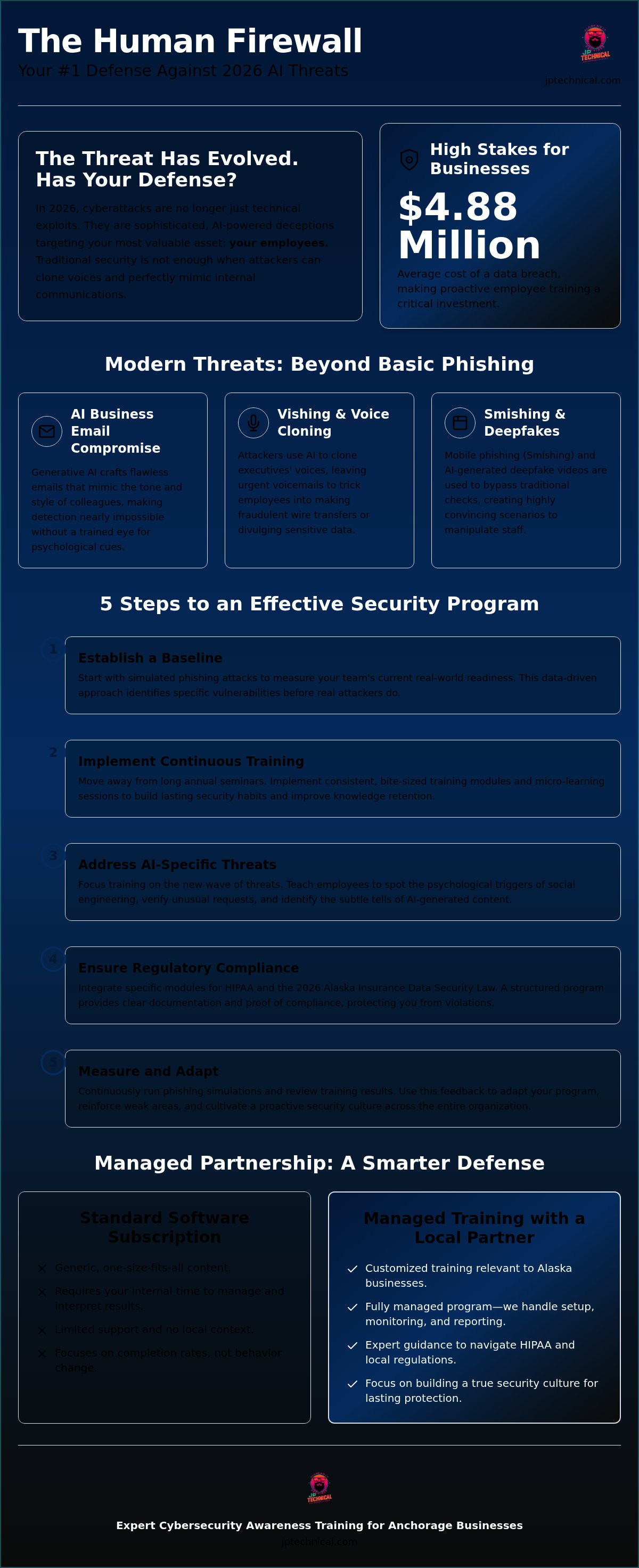
5 Steps to Implementing an Effective Training Program
Moving from a passive security posture to a proactive one requires a structured approach. You can’t simply buy a software subscription and expect your risks to vanish. Successful cybersecurity awareness training for employees relies on a methodical rollout that builds confidence rather than anxiety. By following these five steps, you’ll transform your team into a reliable line of defense that protects your business from the inside out.
Step 1: Baseline Testing. Start by conducting a blind, simulated phishing attack. This provides an honest look at your current vulnerability without any prior warning or instruction.
Step 2: Role-Based Content. A person in accounting faces different risks than someone in a warehouse. Tailor your training so HR learns about malicious resumes while Finance focuses on invoice fraud.
Step 3: Continuous Reinforcement. The 2026 threat landscape changes weekly. Use monthly micro-learning sessions to keep security top-of-mind without causing training fatigue.
Step 4: Simulated Phishing. Regularly test your team with safe, simulated threats. This turns theoretical knowledge into a practical skill they can use every day.
Step 5: Measurement and Feedback. Track your progress. Use the data to refine your approach and reward those who actively identify and report suspicious activity.
Measuring What Matters
Many business owners focus solely on the “click rate,” but that only tells half the story. While you want clicks to go down, you want your “report rate” to go up. When an employee flags a suspicious email using your reporting tool, they’re actively stopping a potential breach. If you have “repeat offenders” who struggle with simulations, approach them with empathy and extra coaching. Punishment often leads to employees hiding their mistakes, which is a significant risk. A high reporting rate indicates a healthy, vigilant security culture.
Gamification and Employee Engagement
We’ve found that making training neighborly and non-punitive keeps morale high. Use leaderboards or small rewards, like gift cards to a local Anchorage coffee shop, for those who spot the most simulations. To make the training feel relevant, use local Alaska examples in your simulations. A fake email about the Permanent Fund Dividend or a local utility notice feels more urgent and realistic than a generic template. This localized approach ensures your team stays engaged and alert to the threats that actually land in their inboxes. Modern cybersecurity awareness training for employees works best when it feels like a shared mission rather than a chore. Get a baseline of your security posture today
Managed Cybersecurity Training: Why a Local Partner Matters
Buying a software subscription for your staff is a start, but it often leaves business owners with a pile of data they don’t have time to interpret. A managed security partnership is different. Instead of managing a portal yourself, you have a dedicated ally who oversees the entire program. We ensure that cybersecurity awareness training for employees is actually working by analyzing results and adjusting the curriculum to meet your specific needs. This proactive care is what separates a simple tool from a long-term safety strategy.
Working with an Anchorage-based IT team provides a level of accountability that national vendors cannot match. We understand the local business environment, the specific regional threats, and the importance of community trust in Alaska. When you combine this localized training with our broader Managed Cybersecurity services, you create a unified defense. Your human firewall and your technical filters work in sync to block threats before they disrupt your operations.
The JP Technical Approach: Steady Reliability
We act as your local guardian, handling technical complexities in the background so you can focus on your core business. Our team specializes in customizing training for HIPAA-heavy environments, ensuring that every lesson reinforces the specific privacy standards required for medical and financial practices. If an employee has a question about a suspicious email in real-time, they have direct access to local experts who can provide immediate, clear answers. This human connection reduces anxiety and empowers your staff to make the right decisions under pressure.
Next Steps for Your Alaska Business
Waiting for a breach to happen is a high-risk strategy that rarely ends well for small businesses. Taking a proactive stance today ensures that your team is prepared for the AI-driven threats of tomorrow. We invite you to take the first step by requesting a Free IT Assessment. This evaluation helps us identify your team’s current vulnerabilities and provides a clear roadmap for improvement. Our goal is to provide the steady reliability you need to operate with total peace of mind, knowing that your local specialist is always standing watch.
Build Your Human Firewall Today
Protecting your Alaska business in 2026 requires more than just updated software. It demands a team that can spot a deepfake voice or a sophisticated AI-generated email before a single click causes a breach. By implementing continuous cybersecurity awareness training for employees, you move beyond simple compliance and create a culture of vigilance. This proactive approach ensures your operations remain predictable and your patient data stays secure under strict HIPAA standards.
Since 1996, JP Technical has served as a local guardian for Anchorage businesses. We specialize in HIPAA-compliant solutions and integrate managed IT with physical security to provide comprehensive protection. You don’t have to handle these technical complexities alone. Secure your team with a Free IT & Security Assessment from JP Technical We’re here to provide the steady reliability and peace of mind you deserve. Let’s work together to keep your business safe and your team prepared for whatever comes next.
Frequently Asked Questions
What is the most effective way to train employees on cybersecurity?
The most effective approach involves continuous micro-learning combined with role-based simulations. Instead of one-off annual meetings, short monthly modules keep the concepts fresh. Using real-world Alaska scenarios, such as Permanent Fund Dividend scams, increases engagement and relevance. This approach ensures that cybersecurity awareness training for employees becomes a habit rather than a chore, leading to better retention and faster threat recognition during a real attack.
How often should cybersecurity awareness training be conducted?
You should conduct training at least once a month through bite-sized modules and quarterly through deeper phishing simulations. Annual training is no longer sufficient because the threat landscape changes too quickly in 2026. Frequent reinforcement helps your team maintain a high level of vigilance. If your staff only hears about security once a year, they’ll likely forget the critical red flags needed to stop a sophisticated AI threat.
Is cybersecurity training required by HIPAA for Alaska medical practices?
Yes, the HIPAA Security Rule mandates regular security awareness training as part of its Administrative Safeguards. For medical practices in Anchorage or Fairbanks, failing to provide this training can lead to “willful neglect” classifications during an audit. Documentation of these sessions is essential for proving compliance. We help you maintain these records so you’re always prepared for regulatory inquiries or cyber insurance renewals.
Can cybersecurity training really prevent AI deepfake attacks?
Training is the primary way to stop deepfake voice and video attacks that bypass technical filters. While software can’t always detect a cloned voice, a trained employee will notice unnatural speech patterns or requests that deviate from standard business protocols. Establishing “out-of-band” verification rules ensures that your team confirms any financial request through a second, trusted channel before taking any action.
What should be included in a 2026 cybersecurity training program?
A modern program must include modules on AI voice cloning, deepfake video detection, and mobile-based smishing attacks. It should also cover 2026-specific regulations like the Alaska Insurance Data Security Law. Beyond technical threats, include training on physical security and remote work safety. This ensures your team is prepared for decentralized work environments where traditional office boundaries no longer exist and data is often handled in rural areas.
How do we measure the ROI of employee security training?
Measure success by tracking the increase in your report rate and the decrease in successful phishing clicks. A high report rate shows that employees are actively engaging with your security protocols. You can also calculate ROI by comparing the cost of training against the $4.88 million average global cost of a data breach reported by ORDR in 2026. Reduced insurance premiums often provide additional financial benefits.
What happens if an employee fails a simulated phishing test?
Use a failed test as a non-punitive coaching opportunity rather than a disciplinary event. Provide immediate training that explains exactly what the employee missed in the simulation. If you create a fearful environment, staff may hide real mistakes. Instead, encourage open communication and offer extra support to those who struggle with specific types of digital deception. This builds trust and strengthens your overall security culture.
Does our Alaska small business really need a local IT partner for training?
A local partner provides accountability and specialized knowledge that national software vendors lack. We understand the specific challenges of operating in Alaska, from rural connectivity issues to local regulatory nuances. Having an Anchorage-based expert means your team can get real-time answers from someone who knows your business personally. This partnership transforms cybersecurity awareness training for employees from a generic task into a tailored, proactive defense strategy.
 Article by
Colter Hobbs