Managed IT vs. Break-Fix: 2026 Alaska Business Guide
What if your IT provider actually earns more money when your business grinds to a halt? It’s a troubling thought, but it’s the core reality of the reactive support model. Many Alaska business owners feel stuck in a cycle of “emergency” calls and unpredictable invoices. You want to focus on your operations; instead, you’re waiting for a call back while your team sits idle and downtime costs climb as high as $427 per minute. It often feels like your IT support is always a step behind the latest cyber threat or HIPAA audit requirement.
We believe you deserve technical stability and predictable costs to thrive in our unique landscape. This guide explores the critical differences between managed IT vs break-fix to help you determine which model truly protects your bottom line and security. You’ll discover how shifting from a “fix it when it’s broken” mindset to proactive vigilance can eliminate budgeting surprises and keep you compliant with the 2026 Alaska insurance data security laws. We will compare the long-term value of a dedicated local partnership against the hidden risks of reactive repairs, providing a clear roadmap for your company’s future.
Key Takeaways
Learn why shifting to a predictable monthly budget eliminates the financial “sticker shock” of emergency repair bills and stabilizes your annual operational costs.
Understand the fundamental incentive gap between managed IT vs break-fix and how aligning your provider’s goals with your uptime protects your productivity.
Identify the critical security vulnerabilities in reactive models that can leave your business exposed to 2026 Alaska data privacy regulations and HIPAA penalties.
Discover how 24/7 proactive monitoring identifies and resolves technical issues before they escalate into expensive, multi-hour outages for your team.
See how a local Anchorage-based partnership provides the specialized vigilance and accountability required to navigate Alaska’s unique business environment.
Table of Contents
Understanding IT Support Models: Break-Fix vs. Managed Services
The Conflict of Interest: Why Reactive IT Fails Modern Businesses
Compliance and Security: Where Break-Fix Leaves You Vulnerable
Transitioning to Proactive Care: How JP Technical Protects Your Operations
Understanding IT Support Models: Break-Fix vs. Managed Services
The choice between managed IT vs break-fix isn’t just a technical decision; it’s a strategic one that dictates how your company handles risk. For many years, the standard approach was simple: when a computer stopped working, you called a technician to fix it. This is the foundation of the break-fix model. However, as business technology has become more complex and integrated, a more comprehensive approach known as managed services has emerged as the preferred standard for organizations that cannot afford unexpected downtime. Understanding IT Support Models requires looking past the immediate repair and focusing on the long-term health of your entire network.
What is Break-Fix IT Support?
The break-fix model operates on a reactive, pay-as-you-go basis. You only interact with your IT provider when a specific failure occurs, such as a server crash or a printer malfunction. The provider bills you an hourly rate for the time spent on that single repair. While this might seem cost-effective during months when everything runs smoothly, it creates significant vulnerabilities. There’s no ongoing monitoring to catch failing hardware or security gaps before they become disasters. This model often leads to unpredictable monthly expenses and varying response times, as you’re essentially just another ticket in a queue during a crisis.
What are Managed IT Services?
Managed IT services represent a shift toward a proactive partnership. Instead of waiting for a disaster, a provider monitors your network 24/7 for a predictable flat fee. This includes essential layers like backup and disaster recovery, patch management, and EDR. The goal is to identify and resolve “quiet” issues, like a failing hard drive or an outdated security patch, before they impact your operations. This approach turns IT from a source of anxiety into a stable, managed utility. If you’re unsure where your current setup stands, a free IT assessment can help identify hidden gaps in your network.
In 2026, the “if it ain’t broke, don’t fix it” mentality is a dangerous gamble for Alaska businesses. Modern cyber threats and new insurance regulations mean that by the time you notice something is “broken,” the damage might already be irreversible. A proactive mindset ensures that your systems are always updated and defended, moving you away from the stress of the emergency call. This shift in mindset from reactive to proactive is what separates growing businesses from those constantly sidelined by technical debt.
The Conflict of Interest: Why Reactive IT Fails Modern Businesses
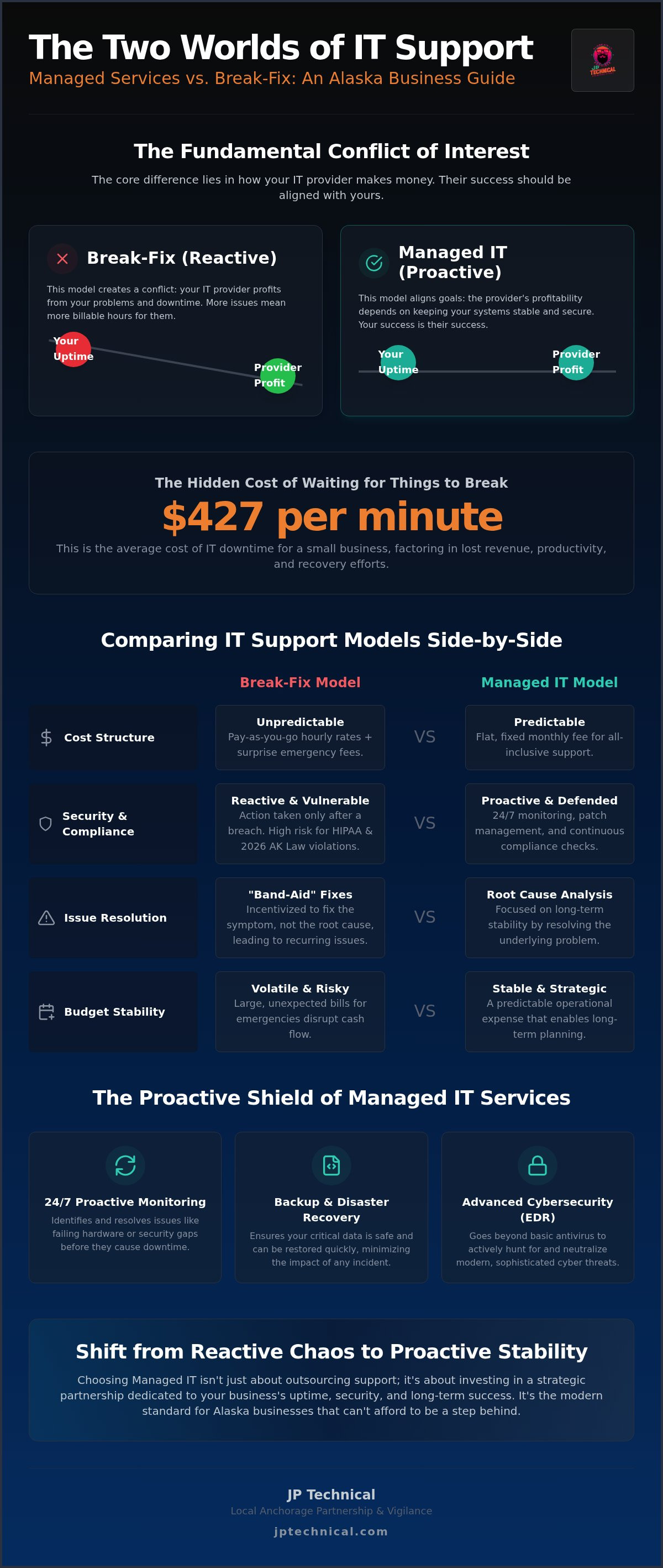
The fundamental flaw in the break-fix model lies in the incentive structure. If your systems are running perfectly, a break-fix technician isn’t making any money. This creates a natural conflict of interest where the provider profits from your technical failures. When you compare managed IT vs break-fix, you see that a managed provider’s profitability depends entirely on your network’s stability. If your systems stay up, their costs stay down, which aligns their success directly with yours.
This alignment is especially critical when implementing managed cybersecurity Anchorage businesses can rely on. A reactive provider might install a basic firewall, but they have little incentive to monitor it 24/7 or adjust for emerging threats. They wait for a breach to happen before they act. By then, the damage is done. A proactive partner remains vigilant, treating Compliance and Security as a continuous process rather than a one-time repair.
The Hidden Costs of Recurring Issues
Break-fix support often results in “band-aid” solutions. Technicians are incentivized to fix the immediate symptom quickly to move to the next billable hour rather than investigating the root cause. This leads to the accumulation of technical debt, which is the long-term cost of choosing an easy, temporary fix now instead of a better approach that takes longer. Over time, these small glitches drain employee productivity and eventually lead to massive, expensive system crashes. If you want to see how much technical debt is hiding in your network, a free IT assessment can provide the clarity you need.
Strategic Partnership vs. Service Vending
Choosing a managed model transforms your IT provider into a strategic partner, often acting as a Virtual CIO (vCIO). They don’t just put out fires; they help with long-term planning and budgeting. This partnership extends to your physical security and access control systems as well. In a reactive model, a failed security camera might go unnoticed for weeks. A managed partner monitors these critical assets alongside your network, ensuring your building stays as secure as your data. This continuous oversight extends the lifespan of your hardware assets by ensuring they are maintained and updated properly, rather than run until they fail.
Financial Realities: Comparing the True Cost of IT Support
The debate between managed IT vs break-fix often starts with a simple look at the hourly rate. On paper, paying for a technician only when something breaks seems like a logical way to save money. This perspective, however, ignores the indirect costs that can cripple an Alaska small business. While a break-fix invoice represents a visible direct cost, the hidden financial impact of system failure is often much higher. Managed services trade these volatile, high-risk expenses for a stable, predictable line item that simplifies your annual budgeting.
The Downtime Calculator
When your network goes down, your expenses don’t stop. You’re still paying for idle employees who cannot access files, process orders, or communicate with customers. According to Gartner’s analysis of downtime, the financial drain of an outage is staggering. Verified research from 2026 indicates that small businesses can lose between $137 and $427 per minute during an IT outage. These figures reflect more than just lost sales; they include the cost of paying staff who cannot work and the long-term damage to your professional reputation.
To calculate your business’s specific “cost per hour” of downtime, you should add your total hourly payroll for all affected staff to your average hourly gross revenue. In many cases, this calculation reveals that a single day of total system failure costs significantly more than an entire year of proactive, managed support. If a customer cannot reach you because your server is down, they may quickly move to a competitor. In our local community, a reputation for being unreliable is difficult and expensive to repair.
Emergency Surcharges and Hidden Fees
The “Alaska factor” adds another layer of complexity to the reactive model. In Anchorage, Wasilla, or the Kenai Peninsula, emergency local dispatch fees can skyrocket if a technician isn’t already monitoring your systems. Break-fix providers often charge significant surcharges for “after-hours” or “emergency” responses. These fees create “bill shock” that makes it nearly impossible to maintain a predictable monthly budget. You’re essentially paying a premium for a disaster that could have been prevented with steady vigilance.
By contrast, a managed model provides total transparency. You can visit our pricing page to see how a flat-fee structure eliminates these expensive surprises. This predictability allows you to reinvest in your operations rather than keeping a “rainy day” fund for technical emergencies. Comprehensive plans also integrate the disaster recovery services Anchorage businesses need to remain resilient. When your IT costs are fixed, your provider wins only when your systems stay up, protecting both your cash flow and your peace of mind.
Compliance and Security: Where Break-Fix Leaves You Vulnerable
In 2026, cybersecurity is no longer a task you can check off a list once a quarter. It requires constant, 24/7 vigilance to counter threats that evolve by the hour. When comparing managed IT vs break-fix, the security gap becomes a chasm. A break-fix provider only looks at your systems when they are already compromised or broken. This leaves your business exposed to unpatched software and outdated firewalls for weeks or months between service calls. With 41% of small businesses experiencing a cyberattack in 2023, according to industry research, relying on a reactive “on-call” technician is a high-stakes gamble with your company’s data.
HIPAA and Regulatory Risks in Alaska
For medical practices and legal firms, the stakes are even higher due to strict regulatory requirements. The Alaska Personal Information Protection Act (APIPA) imposes civil penalties of up to $500 for each resident not notified of a breach, with a maximum penalty of $50,000. Additionally, new insurance data security laws (SB 134) taking effect in 2026 and 2027 demand rigorous documentation. A reactive IT model cannot provide the continuous audit trails required to prove compliance during an audit. Our specialized HIPAA services ensure that your patient data remains protected under a watchful eye rather than waiting for a failure to trigger a response.
Compliance is a marathon, not a sprint. Using proactive IT maintenance Anchorage businesses can depend on keeps you audit-ready at all times. We manage the background details, like encryption verification and access logs, so you don’t have to scramble when a regulator knocks on your door. This steady approach eliminates the anxiety of “what-if” scenarios by replacing them with documented, verifiable safety measures.
The Convergence of IT and Physical Security
The unique logistics of Alaska, including potential delays in shipping hardware or technician travel, make proactive monitoring essential. Your physical security and access control systems are now part of your digital network. If a security camera or a keycard reader fails in a break-fix environment, you might not realize it until you actually need the footage or find a door unlocked. Standalone security systems that aren’t monitored by a managed provider are frequent targets for hackers and are prone to silent failures.
We treat your physical and digital security as a single, integrated shield. By monitoring these assets alongside your servers, we identify hardware issues before they leave your facility vulnerable. This level of integrated protection is the only way to ensure your business remains a difficult target for both digital and physical intruders. If you’re concerned about hidden vulnerabilities in your current setup, you can schedule a comprehensive security review to identify and close those gaps before they are exploited.
Transitioning to Proactive Care: How JP Technical Protects Your Operations
Moving away from the reactive cycle doesn’t happen overnight; it requires a methodical shift in how your business views its technical infrastructure. At JP Technical, we call this the “Guardian” approach. Instead of profiting from your downtime, we invest our time in preventing it. When you evaluate managed IT vs break-fix, the most significant difference you’ll notice is the immediate sense of order. We begin by auditing your current environment to find hidden break-fix vulnerabilities that a reactive technician might have overlooked for years. This includes checking for unpatched software, weak access controls, and failing hardware that hasn’t triggered an alert yet.
Our onboarding process is designed to move your business from technical chaos to predictable stability. We understand that Alaska businesses face unique challenges, from erratic power grids to the logistical hurdles of getting replacement parts to the Kenai Peninsula. Our goal is to handle these threats quietly in the background so you can focus on your core operations. It’s about creating a foundation where your technology supports your growth instead of hindering it.
What to Expect in Your First 90 Days
The first three months are about stabilization and discovery. We perform a deep-dive security and performance assessment to map every corner of your network. If we find gaps, we resolve them immediately. We prioritize implementing proactive backups and disaster recovery protocols to ensure your data is safe, regardless of what happens. During this time, we also set up our helpdesk for your team. This gives your employees immediate support for daily technical hurdles, reducing the frustration of waiting for a “callback” from an overbooked on-call technician. We want your staff to feel supported and confident from day one.
Your Local IT Partner
Accountability is the foundation of a successful partnership. We’ve been serving the Anchorage, Mat-Su, and Kenai business communities since 1996. Having technicians who live and work in Alaska provides a distinct advantage. We understand the local landscape and the specific regulatory pressures you face. Unlike national call centers, we don’t treat your business like a ticket number in a distant database. We’re your neighbors, and we take our role as your local guardian seriously. This local presence means we understand how shipping delays or extreme weather can impact your hardware needs, and we plan accordingly.
Choosing a proactive partner means you’re no longer alone in managing cyber threats or compliance hurdles. It’s about having a specialist who shows up when things get difficult and stays until the job is done right. If you’re ready to leave the stress of reactive repairs behind, schedule your free IT assessment today to see how we can secure your operations and provide the peace of mind you deserve.
Securing Your Business Future in Alaska
Choosing between managed IT vs break-fix is about more than just how you pay your bills. It’s a strategic decision to move away from a model that profits from your technical failure and toward one that rewards your stability. By prioritizing proactive care, you eliminate the “bill shock” of emergency repairs and ensure your network meets the rigorous 2026 Alaska data security standards. You gain the freedom to focus on your growth while a dedicated team handles the technical vigilance in the background, keeping your operations smooth and secure.
Since 1996, JP Technical has acted as a local guardian for our business community. As HIPAA compliance specialists with a local Anchorage-based support team, we understand the specific logistical and regulatory hurdles you face every day. We’re here to help you move from technical chaos to steady, predictable operations that protect your bottom line. You don’t have to navigate these complex technical shifts alone; a reliable expert is ready to guide you toward a more resilient future.
Ready for predictable IT? Schedule your free assessment today.
Frequently Asked Questions
What is the difference between break-fix and managed IT services?
The primary difference lies in the incentive structure and timing of the support. In a break-fix model, you pay a technician an hourly rate only after a system fails. Managed IT services involve a partnership where a provider monitors your network 24/7 for a flat monthly fee. This fundamental shift in managed IT vs break-fix dynamics turns your provider into a proactive guardian who works to prevent issues before they cause downtime.
Is managed IT services more expensive than break-fix?
Managed IT usually has a higher upfront monthly cost but is often cheaper when considering the total cost of ownership. Break-fix invoices are unpredictable and often include emergency surcharges. When you factor in the 2026 average downtime cost of up to $427 per minute, a flat-fee subscription provides better financial stability. It eliminates the “sticker shock” of major system failures and allows for precise annual budgeting.
Can a break-fix provider help with HIPAA compliance?
Most break-fix providers lack the continuous monitoring tools required to maintain rigorous HIPAA standards. Compliance isn’t a one-time fix; it requires ongoing audit trails, encryption verification, and access logs. A reactive technician only sees your system during a crisis, which means they cannot provide the documented vigilance needed for a successful federal audit or to meet Alaska’s 2026 insurance data security regulations.
How quickly can a managed IT provider respond to an emergency?
Managed IT providers typically respond faster because they already have remote access and monitoring tools installed on your network. Since we monitor your systems 24/7, we often resolve issues before you even notice them. If a critical failure occurs, our local Anchorage-based team can prioritize your business based on a predefined service level agreement, ensuring you aren’t stuck waiting at the bottom of a busy technician’s queue.
Does managed IT include hardware costs?
Generally, managed services cover the labor, monitoring, and software tools, while hardware remains a separate capital expense. However, your provider acts as a consultant to help you plan hardware life cycles. This prevents emergency purchases of expensive equipment. By maintaining your current assets through regular patching and updates, we extend the lifespan of your servers and workstations, ensuring you get the maximum ROI from every device you buy.
What happens to my physical security systems if I switch to managed IT?
Your physical security assets, such as cameras and access control, are integrated into your managed IT environment for better protection. We monitor these devices alongside your servers to ensure they remain online and secure. If a camera fails or a door controller loses connection, our team receives an alert immediately. This unified approach prevents the silent failures that often plague standalone security systems in a reactive support model.
Is managed IT worth it for a very small business in Anchorage?
Yes, because a single data breach or a day of downtime can be catastrophic for a small Anchorage business. The managed IT vs break-fix debate for SMBs often comes down to risk tolerance. Small firms are frequent targets for cyberattacks because they often lack professional defense. A managed plan provides enterprise-level security and HIPAA-compliant backups that would be unaffordable to build and maintain on your own.
How do I transition from my current IT guy to a managed service provider?
The transition begins with a comprehensive audit of your current network to identify existing gaps and technical debt. We coordinate with your current contact to gather administrative credentials and documentation. Our team then installs monitoring and security tools quietly in the background to avoid disrupting your daily operations. This methodical onboarding process ensures a smooth handoff while stabilizing your network for long-term growth and predictable performance.
 Article by
Colter Hobbs