Commercial Access Control Systems Anchorage: The 2026 Guide to Integrated Security
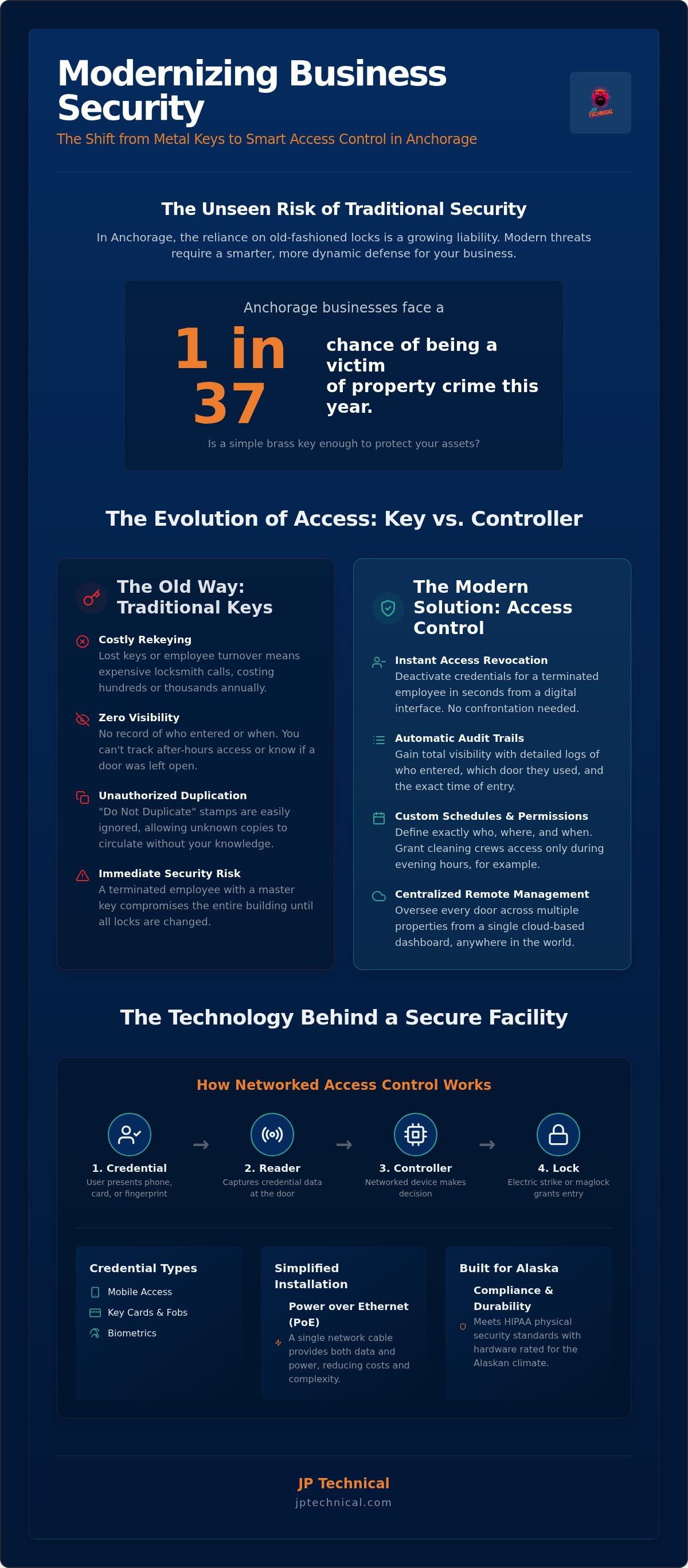
With a 1 in 37 chance of an Anchorage business falling victim to property crime this year, relying on a traditional brass key is no longer a viable security strategy. You’re likely tired of the constant cycle of rekeying locks every time an employee leaves or worrying if a door was left propped open after hours. It’s a heavy burden to manage physical security while trying to stay compliant with evolving Alaska insurance regulations and HIPAA standards.
Modern commercial access control systems Anchorage business owners are adopting now go beyond simple locks. These systems are essential components of your IT and cybersecurity infrastructure. This guide shows you how to secure your facility with network-integrated technology that eliminates key management headaches and improves site safety. You’ll discover how to transition to a keyless office environment that offers remote management and automatic audit trails for total visibility. We will also examine the latest 2026 trends in cloud-based hardware and explain how to integrate your physical security with your existing network to ensure your business remains protected against both local threats and regulatory hurdles.
Key Takeaways
Stop dealing with the high cost of lost keys and rekeying locks. You’ll gain the ability to revoke access credentials instantly through a digital management interface.
Understand how modern door controllers function as networked devices to provide remote management and streamlined Power over Ethernet installation.
Evaluate different credential types like mobile access and biometrics to determine the best fit for your building’s security level and budget.
Maintain compliance with HIPAA physical security standards while using hardware specifically rated for the unique challenges of the Alaska climate.
See how the integrated commercial access control systems Anchorage businesses use provide automatic audit trails and total visibility into who enters your building.
Table of Contents
Beyond the Metal Key: Why Anchorage Businesses Are Modernizing Entry Systems
Networked Access Control: Integrating Physical Security with Your IT Infrastructure
Compliance and Durability: Meeting HIPAA Standards in the Alaska Climate
Securing Your Perimeter with JP Technical: Professional Installation and Management
Beyond the Metal Key: Why Anchorage Businesses Are Modernizing Entry Systems
For decades, Anchorage business owners relied on heavy key rings and standard deadbolts. Today, that’s a liability. Commercial access control is essentially the digital management of “who, where, and when.” It defines who can enter a specific door, which areas they can access, and exactly when they’re permitted to be there. This framework of physical and information security access control ensures your facility isn’t just locked, but actively managed. Traditional keys are static; once they’re cut, you lose control over where they go. Modern commercial access control systems Anchorage companies use provide a dynamic layer of protection that adapts to your daily operations.
Every time an employee leaves or a key goes missing, you face the bill for a locksmith. Rekeying a standard office building in Southcentral Alaska can cost hundreds or even thousands of dollars over a single year. There’s also the lost productivity of managers spending hours tracking down physical sets or waiting for service calls. Digital systems replace this friction with a simple software interface, allowing your team to focus on their work instead of managing hardware.
The Limitations of Mechanical Locks in 2026
Physical keys carry inherent risks that don’t fit the modern workplace. If an employee with a master key leaves on bad terms, your entire building is compromised until every cylinder is changed. You also have zero visibility into after-hours activity. You don’t know if a contractor entered at 2:00 AM or if a back door was left propped open. Mechanical locks can’t stop unauthorized duplication either. “Do Not Duplicate” stamps are often ignored by automated kiosks or online services, making it easy for unauthorized copies to circulate without your knowledge.
The Benefits of a Keyless Anchorage Office
Transitioning to physical security that’s keyless offers immediate relief for administrators. You can revoke access for a terminated employee with a single click, removing the need for a physical confrontation over a key return. You can also set custom schedules. For example, your cleaning crew might have access only between 6:00 PM and 10:00 PM, while your executive team has 24/7 entry. If you manage multiple properties across the Mat-Su Valley or in Fairbanks, you can oversee every door from one central dashboard in Anchorage. This level of predictability is what keeps local businesses running smoothly despite the high property crime rates in our region.
Networked Access Control: Integrating Physical Security with Your IT Infrastructure
Modern commercial access control systems Anchorage installations aren’t just electrical projects; they’re IT deployments. A door controller is a specialized computer that lives on your local area network, communicating with a central server to grant or deny entry in real time. If you treat your door security as a standalone hardware task, you miss the opportunity to create a unified defense. Integrating these systems into your existing IT infrastructure eliminates security silos, ensuring that your door logs, surveillance footage, and user directories all work in harmony rather than as isolated islands of data.
Installation is significantly more streamlined thanks to Power over Ethernet (PoE) technology. Instead of running separate high-voltage lines to every door, a single network cable provides both the power and the data connectivity required for the controller. This reduces labor costs and simplifies troubleshooting. While a traditional locksmith understands the metal and mechanics of a strike plate, your IT provider understands the protocols and packets that make the system function. Choosing a partner who can manage the network side ensures your security isn’t just “bolted on” but is a fundamental part of your business operations. If you’re unsure how your current network would handle a modern security upgrade, a free IT assessment can identify potential bottlenecks.
Cloud-Based vs. On-Premise Management
The shift toward cloud-managed portals has changed how Anchorage managers oversee their facilities. Cloud systems host your access data in secure, redundant environments, meaning you don’t have to maintain a dedicated server in your closet. You can manage permissions from a smartphone while you’re at home or traveling. However, on-premise servers still make sense for specific Alaska industries, such as remote research labs or high-security government contractors, where air-gapped networks and localized data control are mandatory for compliance.
Cybersecurity for Your Physical Doors
Protecting your door controllers from network-based attacks is just as important as the physical lock itself. Hackers often target unpatched IoT devices to gain a foothold in a corporate network. Referencing the NIST Guide to Industrial Control Systems (ICS) Security is vital for understanding how to segment these devices properly. Regular firmware updates are a necessity to close vulnerabilities as they’re discovered. Our managed IT services provide proactive monitoring and patching to ensure your door systems remain uncompromised by hackers.
Choosing the right credential is a balance between operational convenience and the specific risks your business faces. For commercial access control systems Anchorage businesses must select technology that stands up to heavy daily use while remaining simple for employees to navigate. Whether you manage a small retail shop or a large medical complex, your choice of credential dictates the long-term cost and security of your entry points. Selecting a system that scales with your headcount ensures you won’t need to replace expensive hardware as your team grows.
RFID and Proximity Keycards
Physical badges remain the standard for many Anchorage offices because they’re familiar and reliable. Proximity cards and fobs are durable, making them ideal for employees who work in industrial settings. However, not all cards are created equal. Standard 125kHz proximity cards are vulnerable to cloning with inexpensive tools. If your business handles sensitive data, we recommend encrypted smart cards using 13.56MHz technology. These use advanced handshake protocols to prevent unauthorized duplication.
Mobile Credentials and Smartphone Entry
Mobile credentials transform how managers handle high turnover. Employees use smartphones via Bluetooth or NFC, eliminating the recurring cost of plastic badges. If a phone is lost, the digital key is revoked instantly through your management portal. This technology supports touchless access, which is a major benefit for Anchorage healthcare facilities. You can also issue temporary keys to contractors that expire automatically, ensuring security remains tight without manual intervention.
Biometric and High-Security Options
For sensitive areas like server rooms, biometric readers provide definitive identification. These systems use fingerprints or facial recognition to ensure the person at the door is authorized. While the initial investment is higher, it removes the risk of shared or stolen credentials. Many Anchorage businesses use a dual-factor approach for high-security zones. This requires both a card and a scan, providing an extra layer of protection for your most valuable assets.
Compliance and Durability: Meeting HIPAA Standards in the Alaska Climate
Anchorage healthcare providers face a unique regulatory landscape. commercial access control systems Anchorage installations must do more than just lock doors; they must act as a verifiable shield for patient data. HIPAA’s physical safeguard standards mandate that only authorized personnel enter areas where Protected Health Information (PHI) is stored. This isn’t just about the front door. It extends to every closet, cabinet, and office that houses sensitive digital or physical records. If you don’t have a digital log of who entered these spaces, you’re at risk during a compliance audit.
Access Control for HIPAA Compliance
Compliance isn’t a one-time event but a continuous state of readiness. Modern systems generate automated audit reports that prove exactly who entered a medical records room or a server closet and when. This documentation is vital during an audit. You can learn more about our HIPAA compliance services to see how we bridge the gap between IT security and physical locks. By restricting access to internal sensitive zones, you lower the risk of accidental or malicious data exposure. It’s a proactive way to manage liability and protect patient privacy simultaneously.
Weatherproofing and Alaska Environmental Factors
Hardware that works in the Lower 48 often fails during a typical Anchorage winter. Exterior readers and electronic strikes must be rated for sub-zero temperatures to prevent mechanical seizing or electronic failure. We prioritize hardware that’s been tested in the Kenai and Fairbanks regions, where temperatures frequently drop well below zero for weeks. Wiring must also be protected from environmental wear and potential seismic activity. This is a constant reality in Southcentral Alaska. We ensure that conduit and mounting points are robust enough to handle the ground movement our state is known for.
Choosing a provider with a local presence in Anchorage and Wasilla ensures that if a component fails during a blizzard, help is nearby. We’ve been a part of this community since 1996. We understand the logistical challenges of keeping a business secure in our climate. Our technicians are ready to show up when things get difficult. If your current security setup is struggling with the cold or failing to meet regulatory standards, a free IT assessment can help you identify a more resilient solution. We take a no-nonsense approach to securing your premises.
Securing Your Perimeter with JP Technical: Professional Installation and Management
JP Technical has been a fixture in Southcentral Alaska since 1996. This 30-year history gives us a deep understanding of the local landscape that outside vendors simply can’t match. We’ve seen how Anchorage businesses have evolved, and we’ve adapted our security strategies to meet modern threats. We take a no-nonsense approach to every project. This means we focus on reliable, high-performance hardware and clean network integration rather than flashy, unproven gadgets. When you choose us for commercial access control systems Anchorage, you’re getting a partner who understands both the physical hardware and the complex network it runs on.
A standalone lock is a start, but true security comes from a unified system. Integrating your entry points with commercial security cameras adds a layer of visual verification that simple card readers can’t provide. If an unauthorized person tries to use a stolen badge, your system can trigger an immediate alert and capture high-definition footage of the attempt. This synergy between access control and surveillance ensures your facility is monitored from every angle, providing the peace of mind you need to focus on your core operations.
The JP Technical Installation Process
Our process begins with a thorough site walk-through. We examine every entry point, from the main lobby to the delivery bays and internal server rooms. We identify vulnerabilities that mechanical locks leave exposed. During the installation phase, we work diligently to minimize downtime. We understand that your business doesn’t stop just because you’re upgrading your security. Once the hardware is in place, we provide comprehensive training for your team. You’ll learn how to issue credentials, set schedules, and pull audit reports with confidence. Our commitment doesn’t end at the final handshake; we offer ongoing support and proactive maintenance to keep your hardware functioning perfectly in the Alaska climate.
Schedule Your Free Security Assessment
Every Anchorage facility has unique requirements based on its layout and industry. A generic, “out-of-the-box” security kit won’t provide the protection you need. During a professional security assessment, we identify specific gaps in your current physical and digital defenses. We look at your network’s capacity to handle PoE devices and evaluate your current compliance posture. This allows us to customize a solution that fits your building and your budget. Don’t wait for a security breach to find the weak points in your perimeter. Get started with a Free IT and Security Assessment to ensure your business is protected by a seasoned, local guardian.
Future-Proofing Your Business Perimeter
Establishing a modern entry system is about more than just replacing a metal key. It’s about building a foundation of accountability and network-integrated security that protects your assets around the clock. By treating your door controllers as vital IT assets, you ensure your facility is prepared for both physical unauthorized entry and complex digital vulnerabilities. This integrated approach allows your business to scale while maintaining strict visibility over every entry point, regardless of staff turnover or shifting work schedules.
JP Technical has been a trusted local guardian since 1996. We understand how to deploy commercial access control systems Anchorage owners can rely on, even in our demanding sub-zero climate. As specialists in HIPAA-compliant physical security, we provide dedicated local support across Anchorage, Wasilla, and the Kenai Peninsula. We take a no-nonsense approach to ensuring your hardware remains operational and your data stays protected through every season. Secure Your Business with a Free Security Assessment today to identify your specific risks. We’re ready to help you build a safer, more predictable environment for your staff and your customers.
Frequently Asked Questions
How much does a commercial access control system cost in Anchorage?
The cost for commercial access control systems Anchorage businesses install depends on the number of doors and the choice of credential hardware. While basic keypad systems are more affordable, high-security biometric readers require a larger initial investment. You should also consider recurring licensing fees for cloud-based management. A professional assessment is the only way to get an accurate estimate for your specific facility requirements.
Can I use my existing security cameras with a new access control system?
Yes, most modern access control platforms integrate seamlessly with existing IP-based security cameras. This allows you to link specific entry events to recorded video footage for immediate verification. If your cameras support standard protocols, we can often create a unified dashboard. This integration eliminates the need to toggle between different software programs to see who is at your door.
What happens to the doors if the power or internet goes down?
Your doors remain secure and functional even during a power outage or internet failure. Local door controllers have internal memory that stores user permissions, so they continue to grant access to authorized staff without a network connection. We also install battery backup units to keep the electronic locks powered. Once connectivity is restored, the system automatically syncs its activity logs with the central server.
Is mobile phone entry secure for my Anchorage business?
Mobile credentials are exceptionally secure because they leverage the built-in security of the smartphone, such as facial recognition or fingerprint scanning. The communication between the phone and the reader is encrypted to prevent credential theft. Unlike physical cards, employees rarely lose their phones or lend them to others. This significantly reduces the risk of unauthorized entry compared to traditional brass keys.
How long does it take to install a commercial door badge system?
Installation time varies based on the complexity of your building’s wiring and the number of doors being secured. A standard single-door installation typically takes four to six hours to complete. For larger offices, a full deployment of commercial access control systems Anchorage usually takes between two and five business days. We coordinate the schedule to ensure your business operations continue with minimal interruption during the transition.
Do I need a separate server to manage my building entry system?
You don’t necessarily need a dedicated on-site server to manage your building entry system. Cloud-based solutions host the management software in a secure data center, allowing you to control everything through a web browser. This setup reduces your local hardware footprint and simplifies maintenance. However, some Alaska industries with strict data sovereignty requirements may still prefer an on-premise server for localized control.
Can I manage access for multiple Alaska locations from one app?
You can manage access for multiple Alaska locations from a single mobile app or web portal. This centralized control allows you to grant or revoke permissions for staff in Anchorage, Wasilla, or Fairbanks without being physically present at those sites. You can also view consolidated audit reports for your entire organization. It’s an efficient solution for managers who oversee several regional offices across the state.
Is biometrics legal to use for employee tracking in Alaska?
Biometric systems are legal to use in Alaska, but you must comply with the Alaska Personal Information Protection Act (APIPA). This involves providing clear notification to employees about how their data is collected and stored. Most modern biometric readers store a mathematical representation of a fingerprint rather than an actual image, which helps protect privacy. We recommend reviewing your internal policies to ensure they meet current state disclosure requirements.
 Article by
Colter Hobbs